
Josephson Concrete and Hardscapes · September 22, 2026 · Concrete
When to Pour Concrete in Minnesota
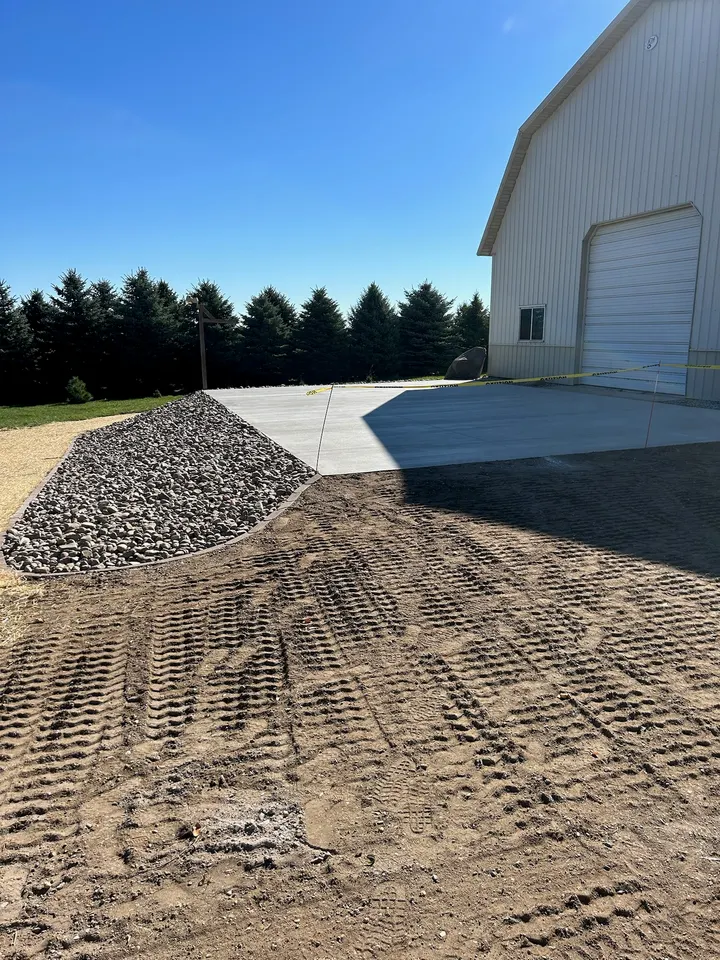
The short answer: concrete season in Minnesota runs roughly from mid-April to October. The ground has to be thawed all the way down, and temperatures should be comfortably above freezing day and night so the concrete can cure. Late spring through early fall is the sweet spot. Once the subgrade freezes in the fall, we stop until it thaws in the spring, because there is no fixing a slab that was poured on frozen ground.
We get asked about timing more than almost anything else, usually in October by someone who wants a garage slab before winter, or in March by someone who wants a driveway before the grass comes in. Here is how we think about it, and what the numbers behind it look like.
The season, in plain terms
From our shop in Cokato the season usually opens in mid to late April, once the frost is out of the ground and the ground has firmed up from the spring melt. It runs through the summer and into October. Some years we get pours in early November. Some years the ground is frozen by Halloween. The calendar is a guide, and the ground and the forecast make the final call.
Within that window, May through September is the easiest stretch. Nights stay above freezing, days are warm but not brutal, and the soil has drained. April and October are the shoulder months, where the work is possible but we watch the forecast closely and sometimes push a pour a few days.
Ground temperature matters more than air temperature
People check the air temperature. We check the ground.
Concrete gains strength through hydration, the chemical reaction between cement and water. That reaction slows sharply as the concrete gets cold and nearly stops as it approaches freezing. A slab poured on cold ground loses heat downward into the soil, and if the ground is frozen, the bottom of the slab can freeze before it has gained any strength at all.
Frozen ground is also not stable ground. Frost expands soil. When it thaws, the soil settles, and it does not settle evenly. A slab poured on top of that follows the settlement, which shows up as cracks, tipping at the joints, or a corner that drops. The 42-inch frost depth Wright County builds footings to is a reminder of how far down winter reaches here.
Before we set forms in the spring, we probe the subgrade. If there is frost in it anywhere under the slab footprint, we wait.
What the cold-weather guidance says
The American Concrete Institute publishes the guidance most contractors work from. Its cold-weather definition is roughly this: a period of three or more days in a row where the average daily temperature is below about 40 degrees Fahrenheit and the air does not climb above about 50 degrees for more than half of any 24-hour stretch. Treat those as approximate thresholds, not switches.
In that kind of weather, concrete can still be placed, but it has to be protected. The concern is that fresh concrete which freezes before it reaches roughly 500 psi of compressive strength is permanently damaged. It loses strength it will never get back and becomes more porous, which in Minnesota means it will scale and spall under salt and freeze-thaw. Getting to that early strength usually takes a day or two of keeping the slab warm, which is why cold-weather pours involve insulated blankets, sometimes a heated enclosure, and a mix adjusted for the conditions.
We do some of that in the shoulder months. We do not do it on frozen ground, and we do not do it in the middle of winter for flatwork, because the cost and the risk both climb faster than the benefit.
Curing in the heat
Summer has its own problem. The same guidance treats hot weather as any mix of high air temperature, high concrete temperature, low humidity, and wind that pulls moisture out of the surface faster than it can be replaced. The commonly cited ceiling for the concrete itself is about 95 degrees at the time it leaves the truck, and the surface-evaporation rate most contractors watch is roughly two tenths of a pound per square foot per hour. Above that, plastic shrinkage cracks show up in the first few hours, before the concrete has set.
On a hot July afternoon near Hutchinson, with a west wind coming across open farm ground, we can hit that evaporation rate easily. So we schedule pours for early morning, wet the base so it does not pull water out of the mix, keep the finishing crew moving, and get a curing compound or wet cover on the surface as soon as the finish will take it. Hot weather does not stop us. It changes how the day is run.
Why we stop in the fall
Every fall we get calls from people who want one more slab poured before winter. Sometimes we can do it. Here is what decides it.
The ground has to be thawed, and it has to stay thawed long enough for the concrete to gain strength. A pour on a warm afternoon in late October that is followed by a hard freeze that night can be saved with blankets, but a pour followed by a week of highs in the twenties cannot. Once the ground freezes down more than an inch or two, the season is over for flatwork.
Fall also brings shorter days. Concrete finishing follows the set of the concrete, not the clock, and a pour that starts at nine in the morning on a cool day can still be waiting for the broom at dusk. That is a long day for the crew and a slab that is harder to finish well. So we make an honest call in the fall: if the forecast and the ground are right, we pour. If either one is wrong, we tell you it is a spring job.
What happens if you pour on frozen ground anyway
We see the results of this on other people’s work every spring. The slab looked fine in November. By May it has a crack across the middle, one side is higher than the other at a joint, or the whole slab has dropped where the frost under it thawed and settled. There is no repair for that other than tearing it out and pouring it again on a proper base.
The second failure is less visible. Concrete that froze early looks normal but never reached its design strength. It scales in sheets the first winter it sees salt, and it keeps scaling. That is the slab that gets blamed on “bad concrete” when the problem was the day it was poured.
Why booking early matters
Everyone who needs concrete in this part of the state needs it inside the same six months. Driveways, garage slabs, patios, pool decks, shop floors, and the flatwork for new construction all compete for the same thawed weeks. The first good stretch in late April and May fills first, and by midsummer the calendar is set through the fall.
If you call in February, we can come out while the ground is still frozen, look at the site, measure, and give you a written quote. Then you are on the list for the first week the ground allows, instead of calling in May and waiting for an opening. The base work can also be planned better when it is not being rushed between rain days.
A rough calendar
- February to March: site visits, measurements, written quotes, and scheduling. Ground is frozen; no flatwork.
- Mid to late April: frost is out on most lots. First pours, with the forecast watched closely.
- May through September: the main season. Long days, thawed ground, good curing.
- October: shoulder month. Pours happen when the ground and the forecast cooperate, with blankets on standby.
- November onward: flatwork stops once the subgrade freezes. Planning for spring begins.
Get on the list
If you have a driveway, patio, or slab in mind for next season, the best time to call is before the ground thaws. We pour concrete across Wright County and the towns along US-12, and we will tell you straight if your project fits this year or has to wait for next.
Want us to look at your yard?
Free written estimate, measured in person, same-day callback.
Questions we get asked
What is the coldest temperature you can pour concrete in?
The industry guideline treats it as cold-weather work once the average daily temperature falls below about 40 degrees for three days in a row. Pouring is possible below that with heated mixes and insulated blankets, but the ground under the slab must not be frozen, and fresh concrete must be kept from freezing until it has gained enough strength, which takes a day or two of protection.
Can you pour concrete on frozen ground?
No. Frozen soil expands, and when it thaws under a new slab it settles unevenly and the concrete cracks or tips. Even a few inches of frost in the subgrade is enough to cause it. We wait until the ground is thawed to full depth, and we probe it before we set forms.
Is it too hot to pour concrete in July?
Rarely too hot, but hot days need care. The concrete itself should stay under roughly 95 degrees at delivery, and hot, dry, windy afternoons pull water out of the surface faster than it can bleed up, which causes plastic shrinkage cracks. We pour early, keep the surface wet or covered, and cure it longer on those days.
When should I call to get on the schedule for a spring pour?
Late winter. Everyone in Wright County wants concrete in the same six months, and the first thawed weeks in April and May fill first. Calling in February or March gets you a site visit before the season opens and a spot on the calendar when the ground is ready.