
Broom or stamped for a patio
Broom finish is a flat gray slab with fine texture lines. It is the least expensive option, the best for traction, and the easiest to keep clean. Most of the patios we pour are broomed, and the ones that need to look like more than a slab usually get a paver border instead of a decorative finish. Stamped concrete presses a pattern into colored concrete: wood plank, flagstone, slate. It looks like stone from a few feet away and costs more because of the color, the stamping labor, and the sealer it needs every two to three years. If the patio is covered or partly shaded, a stamped or sealed finish holds its color longer. If it bakes in the sun all day, plain broom or exposed aggregate ages better with less upkeep.
Pitch, drainage, and keeping water away from the house
A patio sits against the foundation, so where its water goes matters more than on any other slab. We pitch patios away from the house at about an eighth to a quarter inch per foot, which is enough to shed water and not enough to feel on a chair. The top of the slab stays below the siding and below the door threshold. Downspouts that land on the patio get extended past its edge. If the yard slopes toward the house, we regrade or set a drain along the low edge before pouring, because a patio that traps water against a foundation is worse than no patio. On clay lots, which is most of Wright County, the base under the slab is compacted class 5 gravel, so water that gets under the slab drains instead of freezing and lifting it.
Slabs under decks and pads around timber posts
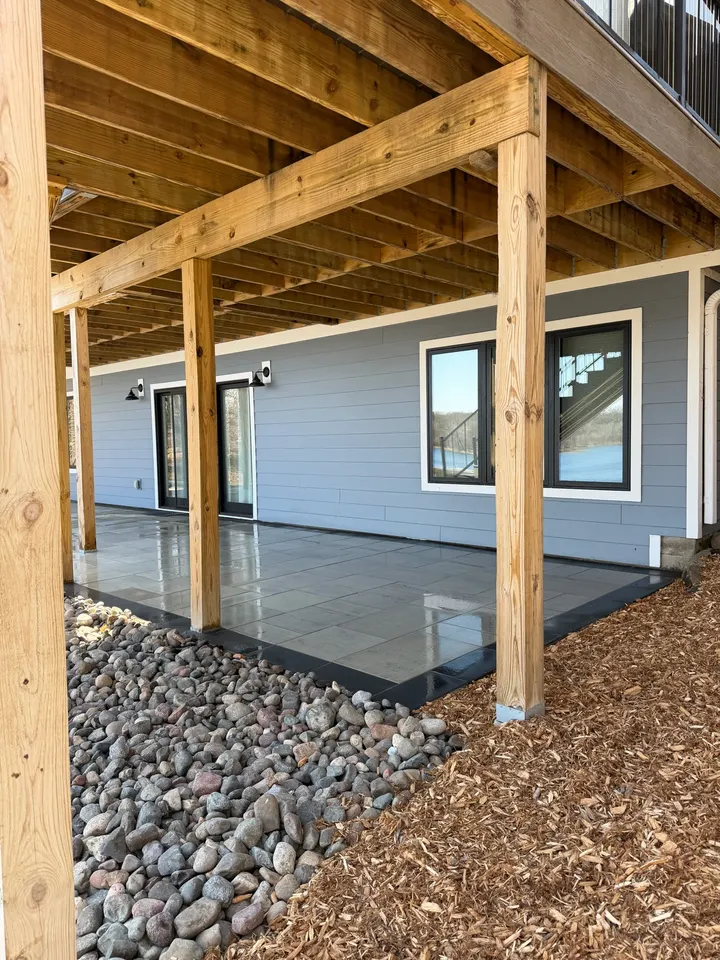
A concrete slab under a deck turns dead space into a dry, usable floor and keeps mud and weeds out from under the stairs. We pour these around the deck's timber posts, with an isolation joint around each post so the slab and the post footing can move independently. The posts themselves sit on frost footings; the slab does not need to. Pitch under a deck still runs away from the house, and because these slabs rarely see sun they get a broom finish for grip. Where a deck slab meets an open patio, we pour both at once so the finish and the joints line up.
Paver borders and fire pits on a poured patio
A single row of pavers set on edge around the outside of a slab, a soldier course, gives a plain concrete patio a finished edge and hides the form line. We set the border on a compacted base at the same height as the slab, tight to the concrete. Fire pits get their own footing so a heavy stone ring does not crack the slab, and we leave the concrete out of the pit itself, using a gravel or paver floor inside the ring for drainage. Seating walls, steps down to the yard, and a walkway to the driveway can all be poured the same day, which is cheaper than coming back.
What drives the cost of a concrete patio
The site visit sets the number. Here is what moves it.
- Square footage and shape, since curves and bump-outs take more forming
- Finish: broom is the baseline, stamped and colored add material and labor
- Paver borders, seating walls, steps, or a fire pit footing
- Removing an old patio or deck, and hauling it away
- Grading and drainage work along the house
- Access for the ready-mix truck, or a pump if it cannot reach the backyard
- Base depth on soft or wet clay
When we would talk you out of it
- A yard where the truck cannot reach and the patio is small. Pumping or wheelbarrowing a small pour drives the cost per square foot up; a paver patio hand-carried through the gate may cost the same and look better.
- A patio the size of a postage stamp. Under about a hundred square feet, the setup costs the same as a bigger slab. We will say so and suggest a landing plus a paver area instead.
- A slab poured against a foundation that already leaks. Fix the grading and the water problem first; a patio on top of it hides the symptom and makes the repair harder later.
What you get
- Pitched away from the house so water never sits at the foundation
- Broom or stamped, with real samples at the site visit
- Compacted gravel base on clay lots
- Isolation joints at posts and the foundation
- Paver soldier-course borders and fire pit footings built in
- Slab under the deck poured with the patio, one trip
How it goes
- 1
Call or use the form
Give us the rough size, whether there is a deck involved, and what finish you are leaning toward.
- 2
Site visit
We measure, check the slope toward the house, find the downspouts, and look at the gate or side yard the truck would use. Finish and paver samples come along.
- 3
Written quote
Thickness, base, finish, borders, fire pit, and drainage are listed separately so you can add or drop pieces.
- 4
Build and clean up
Excavate, base, form, pour, finish, saw-cut, then set the paver border and fire pit. We haul away the spoils and tell you when furniture can go back.
Questions we get asked
Is a concrete patio cheaper than pavers?
Usually, yes. A broom-finished concrete patio is the lowest-cost hard surface per square foot, because it is one pour instead of hundreds of pieces set by hand. Stamped concrete narrows the gap. Pavers cost more up front but can be lifted and reset if the ground moves, while a cracked slab is a cracked slab.
Can you pour a concrete patio under an existing deck?
Yes. We pour around the timber posts with an isolation joint at each one, keep the slab below the ledger and siding, and pitch it away from the house. Headroom is the main limit: we need enough clearance to screed and broom the surface. Low decks sometimes get pavers or gravel instead.
How far should a patio slope away from the house?
About an eighth to a quarter inch per foot. On a twelve-foot patio that is roughly two to three inches of fall from the house to the outside edge, enough to shed rain without feeling tilted. We also keep the slab top below the siding and door threshold, and extend downspouts past the edge.
Do I need footings under a concrete patio?
Not under the slab itself. A patio is a floating slab on a compacted gravel base, and it rides the frost as one piece. Footings to the 42-inch frost depth go under anything attached to the house or carrying weight: steps at the door, a seating wall, deck posts, or a heavy stone fire pit.
Related work
Where we do this work
Patios across western Wright County and the towns around Cokato: Cokato, Howard Lake, Annandale, Maple Lake, Delano, Litchfield, Watertown, Winsted, and the lake roads between them. See the full service area.