
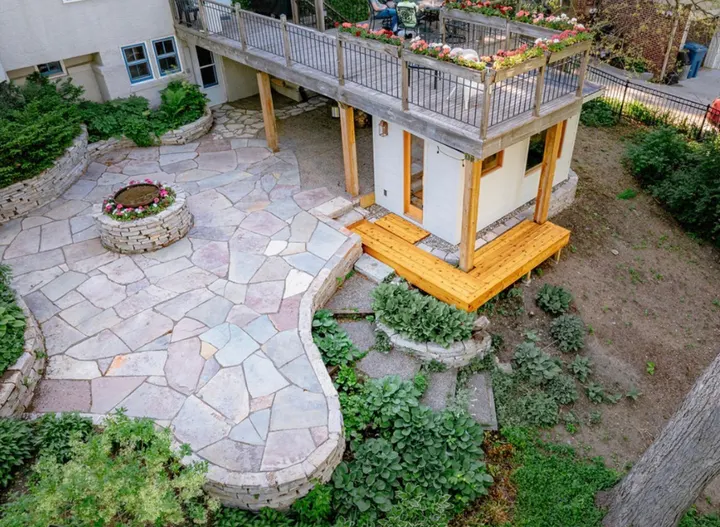
Chilton flagstone, cut and fitted by hand
Chilton is a dolomitic limestone out of eastern Wisconsin. It splits into flat slabs with gray, buff, and soft pink and purple tones in the same load, and it is dense enough to shrug off freeze and thaw. What separates a good flagstone patio from a bad one is the joints. Wide, sloppy gaps filled with a lot of sand look random and wash out. We lay each piece dry, mark it against its neighbors, and cut it with a saw so the joints stay narrow and consistent. That takes time, and there is no shortcut. On the patio under the deck, the flagstone ran up to dry-stacked stone walls on three sides and a round stone fire pit built from the same material, so the whole yard reads as one build.
- Each stone laid dry, marked, and saw-cut to fit its neighbors
- Narrow, consistent joints filled with polymeric sand
- Walls, steps, and fire pit built from matching stone
Paver patios: patterns, borders, and joints
Concrete pavers give you the widest range of looks for the money. We lay running bond, herringbone, and modular patterns in large-format slabs or standard units, usually with a contrasting soldier-course border that frames the field and hides the cuts. Pavers are 60mm thick for a patio, set on one inch of screeded bedding sand, compacted with a plate compactor and a pad so the faces do not scuff, and locked at the perimeter with a spiked edge restraint. Joints get polymeric sand. If a unit ever stains or cracks, we lift that one and drop in a new one.
Pitch, drainage, and where the patio meets the house
A patio that sends water toward the foundation is a wet basement waiting to happen. We set the finished surface below the siding and pitch it about a quarter inch per foot away from the house, so a 12-foot patio drops about 3 inches from the door to the far edge. On lots where the yard rises behind the patio, a low wall with drain tile behind it catches the hillside water before it crosses the stone. The base under all of this is the same one we describe on the hardscape hub: geotextile on the clay, compacted Class 5 in lifts, bedding sand, and an edge restraint.
What drives the cost of a paver or flagstone patio
The quote is mostly square footage and material, but a few site factors move it more than people expect.
- Square footage and shape (curves and cutouts mean more cuts)
- Pavers versus Chilton flagstone, and the pattern chosen
- Excavation depth and hauling clay off the site
- Removing an old deck, slab, or patio first
- Walls, steps, or a fire pit built into the patio
- Access for the skid steer and pallet deliveries
When we would talk you out of it
- A plain rectangle you want poured and done in a day: a broom-finish concrete patio is cheaper and we pour those
- A yard that floods every spring: fix the drainage first, and we can do that as its own job before any stone goes down
- A patio you plan to roof over and enclose within a year: a concrete slab makes a better floor for a future three-season room
What you get
- Chilton flagstone hand-cut with tight joints
- Pavers in any pattern with a soldier-course border
- Base excavated and compacted for clay till
- Pitched away from the foundation
- Edge restraint and polymeric sand standard
- Walls and fire pit from the same crew
How it goes
- 1
Call or send the form
Tell us the size you have in mind and which way you lean, pavers or natural stone. Photos of the yard help.
- 2
Site visit
We measure, check the grade off the house, look at what has to come out, and find the truck path.
- 3
Written quote
Square footage, material, base spec, and any walls or fire pit priced as separate lines.
- 4
Build and clean up
Excavate, base, set, cut, lock, sand, and sweep. Pallets and spoils gone, beds raked back.
Questions we get asked
How long does a flagstone patio take compared to pavers?
Figure roughly twice as long for the same square footage. Pavers are uniform, so a crew sets them fast against string lines. Flagstone is irregular: each piece is laid dry, marked, cut, and reset to keep the joints tight. The base work takes the same time either way. Most patios finish within one to two weeks.
Will a paver patio heave in a Minnesota winter?
A paver patio on a thin base over clay will. One on a properly excavated base with geotextile, compacted Class 5, and drainage will move very little, and pavers are flexible enough to ride minor frost movement and settle back in spring. That is one advantage they hold over a rigid slab.
Can you build a fire pit or seating wall into the patio?
Yes. We build them at the same time so the base, borders, and drainage are planned around them instead of cut in later. A stone or block fire pit, a seating wall, or a short retaining wall on the uphill side is priced as its own line on the quote.
Do you take out an old concrete patio or deck first?
Yes. Removal is a line on the quote. We break up and haul the old slab or deck, and excavate to the depth the new base needs. Old patios often sit on almost no base, which is usually why they cracked or sank in the first place.
Related work
Where we do this work
Paver and flagstone patios across western Wright County and the towns around Cokato: Buffalo, Cokato, Dassel, Howard Lake, Annandale, Maple Lake, Delano, Hutchinson, and the lake roads between them. See the full service area.