
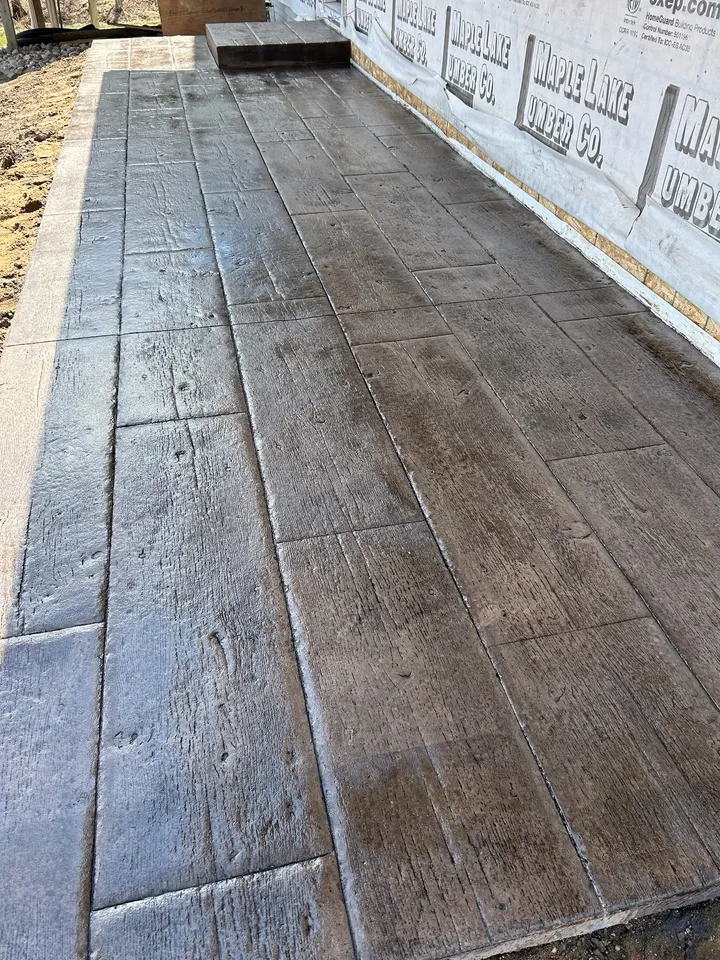
Wood plank, stone, and slate patterns
The wood-plank stamp is the one we get asked about most, and the patio in our photo shows why: individual boards with grain, knots, and slightly varied widths, in a warm brown that reads as wood from the door and as concrete only when you kneel down. It works well on covered patios and porches where real wood would rot. Stone patterns come in random flagstone, ashlar slate (cut rectangles), cobble, and texture skins that give a stone surface with no repeating pattern lines. A pattern with a lot of grout lines hides small imperfections and looks more like laid stone; a large-format slate looks cleaner and more modern. Borders can be a different pattern or a plain broom band, and we lay out the pattern before the truck comes so the joints and the mat lines land where they belong.
Integral color versus broadcast color, and what release does
There are two ways to color the slab. Integral color is a pigment mixed into the truck, so the color runs all the way through. It is more forgiving, because a chip or a worn spot is still colored, and it is the base for most of our stamped work. Broadcast color, also called a color hardener, is a dry pigment and cement blend thrown onto the wet surface and floated in. It gives a denser, harder surface with stronger, more even color, and it is how a wood plank gets its brown over a gray truck. Many jobs use both. Release agent is the powder or liquid put on the surface before the mats go down so they lift clean. Powder release is tinted darker than the base color and is what gives stamped concrete its shadows in the grain and grout lines. We wash the excess off after a day or two and what stays becomes part of the look.
Sealing stamped concrete every two to three years
Stamped concrete has to be sealed. The sealer locks in the color, keeps water and salt out of the surface texture, and gives the pattern its depth. It also wears. Sun, foot traffic, snow shovels, and standing water break a sealer down, and unsealed stamped concrete fades, then scales. Plan on resealing every two to three years, sooner on a driveway and later on a covered patio. We use a sealer with a grit additive on any surface that gets wet, because plain film-forming sealers are slick. Keep deicing salt off stamped concrete entirely and use sand. If you do not want the upkeep, tell us. A broom finish with a paver border is about half the maintenance and we will happily build that instead.
What drives the cost of stamped concrete
Stamped work starts from the same slab as broom finish and adds material and crew time on top of it. What moves the number:
- Square footage, since stamping is labor per square foot on top of the pour
- Pattern: a single texture skin is faster than a plank or ashlar pattern that has to be aligned
- Color system: integral only, broadcast hardener, or both, plus release and sealer
- Borders, bands, or a second pattern that has to be laid out and stamped separately
- Crew size on pour day, because stamping has to happen in a narrow window before the concrete sets
- Everything that drives a plain slab: removal, base, access, thickness, drainage
When we would talk you out of it
- A driveway that gets plowed and salted. The sealer wears fast under a plow blade, salt eats the color, and resealing a driveway every two years gets old. Broom finish with a stamped or paver border at the garage is the better call.
- Anyone who wants a maintenance-free surface. Stamped concrete is the highest-upkeep concrete we pour. If resealing every two to three years is not going to happen, pick broom, exposed aggregate, or pavers.
- A pool deck field where kids run. Sealed stamped concrete is slick when wet. We will do a stamped border around a broom field instead.
What you get
- Real wood-plank, flagstone, slate, and cobble patterns
- Integral and broadcast color, chosen from physical samples
- Pattern laid out before pour day so mat lines land right
- Sealed after cure, with grit added on wet surfaces
- Same compacted base, air-entrained mix, and saw-cut joints as every slab we pour
- Straight talk on upkeep before you sign
How it goes
- 1
Call and tell us the look
Wood, stone, or slate, and where it is going. We will say up front if the location argues for broom instead.
- 2
Site visit with samples
Pattern boards and color chips in daylight, on your site. We check base, access, and drainage the same as any slab.
- 3
Written quote
Slab, color, stamping, sealer, and borders are separate lines. You can see what stamping adds over a broom finish of the same size.
- 4
Pour, stamp, wash, seal
Pour and float, broadcast color if used, apply release, stamp in one continuous push while the concrete is ready, saw-cut, wash the release, and seal after cure.
Questions we get asked
Does stamped concrete last as long as regular concrete?
The slab does. It is the same thickness, base, and air-entrained mix as a broom-finished slab. What wears is the sealer and, if it is neglected, the color and texture on top. Resealed every two to three years and kept off the salt, a stamped patio holds its look for decades. Ignored, it fades and scales within a few winters.
How often does stamped concrete need to be sealed?
Every two to three years for most patios and walks. A stamped driveway or a surface in full sun may need it every two. A covered patio can go longer. The sign it is due is water soaking in instead of beading, and color that looks flat and dusty when dry. Resealing takes about a day.
Is stamped concrete slippery?
It can be. The sealer that protects it forms a film, and film plus water plus smooth texture is slick. We add a grit additive to the sealer on any stamped surface that gets wet, pick textures with more relief for walks and steps, and steer pool deck fields to broom finish with a stamped border.
Can you stamp concrete to look like wood?
Yes. The wood-plank stamp presses individual boards with grain and knots into colored concrete, and a darker release powder settles into the grain for shadow. Finished in a brown or gray, it reads as wood from a few feet away. It works well on covered patios and porches, and it never rots, splinters, or needs staining.
What is the difference between integral and broadcast color?
Integral color is pigment mixed into the truck, so the whole slab is colored and a chip does not show gray. Broadcast color is a dry pigment and cement hardener floated into the surface for stronger color and a harder top. Most stamped jobs use integral as the base and broadcast for the final tone.
Related work
Where we do this work
Stamped concrete across western Wright County and the towns around Cokato: Buffalo, Montrose, Cokato, Dassel, Howard Lake, Annandale, Maple Lake, Delano, and the lake roads between them. See the full service area.