
Getting there
Montrose is about 14 miles east of the shop on US-12, past Howard Lake, around 20 minutes. It sits where MN-25 crosses US-12, so it is on our way to Delano and Watertown and we are through town often. A Montrose site visit is easy to fit into a week.
A 2000s town with 2000s driveways
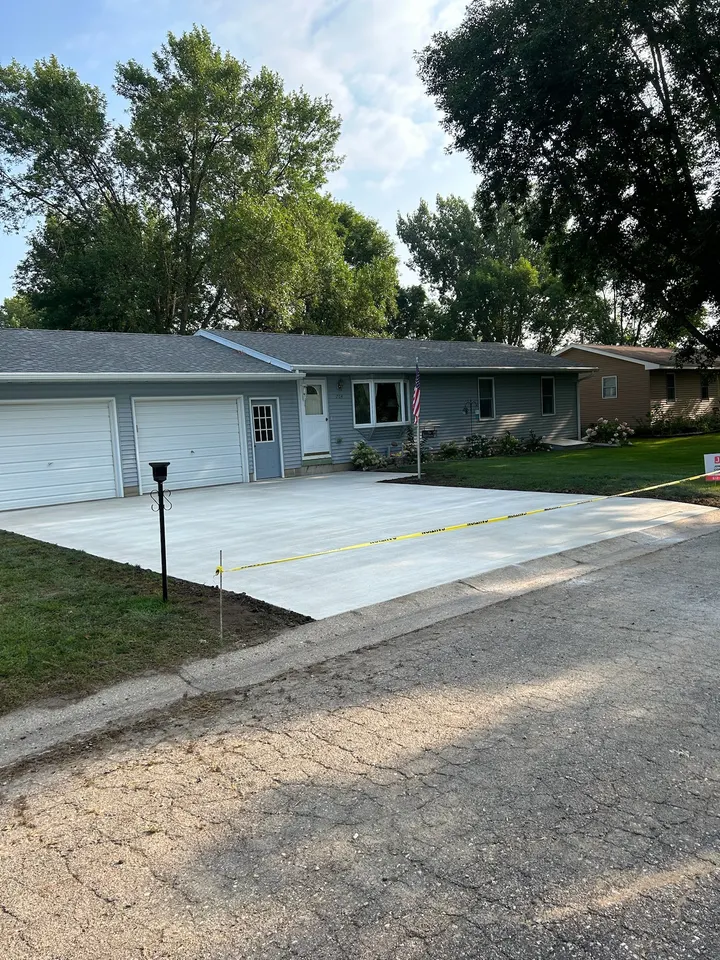
The median Montrose home was built in 2002, and the town's population more than doubled between 2000 and 2010. That build-out happened fast, and the concrete that came with it was the builder's last line item: 4-inch driveways on fill the excavator left, garage aprons never tied to anything, and a patio slab just big enough to hold a grill. Twenty winters on clay have done their work. The aprons have lifted, the panels have settled unevenly, and joints have opened. When we replace a Montrose driveway we pull the old slab, dig to a compacted class 5 base, pour 5 inches with control joints on a real grid, and pitch it away from the garage so meltwater stops running under the door. For patios, the request is almost always bigger than what was there: a broom-finish or stamped slab sized for a table and a fire pit, not a grill.
US-12, MN-25, and the old railroad town
Montrose started as a railroad town, and its business district moved out to US-12 in the 1930s after fires took most of the buildings on Railroad Street. The older homes near the tracks are the exception in a town that is mostly new, and they need the small-town concrete the newer lots do not: a front walk brought back to grade, a stoop that has pulled away from the door, a detached garage slab that has settled. Montrose is about 25 miles from the Twin Cities and most people commute, so we plan the work to happen while you are gone and leave the site clean and the driveway barricaded until the concrete has cured enough to drive on.
Wright County clay and the frost line
Montrose is glacial till, the same clay-heavy soil as Cokato. It holds water, freezes hard, and heaves whatever was poured thin on top of it. Subdivision lots here were graded flat, which means rain has nowhere to go unless the concrete sends it somewhere. We pitch every slab, cut a swale where a yard collects water, and add drain tile where a patio meets the foundation. Anything with a footing, a set of steps or a wall, goes to the 42-inch frost depth Wright County builds to. The concrete season runs from about mid-April into October, and driveway replacements book up early, so spring calls get the best dates.
Concrete flatwork in Montrose
Montrose's concrete work is almost entirely second-generation: replacing the driveways, aprons, and small patios that came with the 2000s houses, on a base that gets compacted this time. How we pour driveways, patios, and pool decks that hold up here.
What we build in Montrose
Questions from Montrose
My Montrose house was built in 2004 and the driveway is already cracking. Why?
Because it was probably poured at 4 inches on fill that was never compacted, which was typical during the town's 2000 to 2009 build-out. Twenty winters of frost on clay lift the apron and settle the panels. We replace it at 5 inches on compacted class 5 with control joints cut on a grid, pitched away from the garage, which is what should have gone in the first time.
Can you pour a bigger patio than the builder slab behind my Montrose house?
Yes, and that is the most common Montrose patio job. We remove the small builder pad, set a compacted base sized for the new footprint, and pour a broom-finish or stamped slab big enough for a table and a fire pit. On a flat subdivision lot we pitch the patio to a swale or drain so water does not sit against the house.
How far is Montrose from your Cokato shop?
About 14 miles east on US-12, around 20 minutes. Montrose sits at the MN-25 crossing, so it is on our route to Delano and Watertown and we are through town often. That makes a site visit easy to line up, usually within the same week during the season.
Nearby
We also work in Delano, Buffalo, Howard Lake and Watertown. All the towns we cover.